Call us now Nederlands

Agentic AI explained

The term Agentic AI is popping up more and more, yet what it actually means tends to vary from person to person. “In my view,” Serge says, “Agentic AI is a self-operating virtual agent. An AI that works within clear boundaries, is fueled by knowledge about one specific task, and can make its own decisions within those limits.”

In other words: an agent that knows exactly what it may and may not do, and that doesn’t depend on human intervention to get its job done.

But such a system only works well when it’s built intelligently: with an orchestrator that manages the overall process and, underneath it, multiple specialized agents that each perform a single task. That’s crucial. Because one agent doing everything? That won’t work. That’s asking for mistakes.

A Practical Example: The Doctor’s Office

To illustrate what Agentic AI means in practice, Serge uses a familiar example: the doctor’s office.

Imagine calling your general practitioner in the evening because you’ve run out of medication and want to request a repeat prescription. The AI recognizes your number, asks you a few verification questions, and checks the system to confirm whether you’re eligible for a refill. Based on the rules in its knowledge base (the information the AI is trained on) the system knows whether it’s allowed to renew that prescription or whether you need to see the doctor first.

And if you do need an appointment, the same AI can immediately check the practice’s schedule.
“You can come in Monday at 10:00 or Tuesday at 11:00. What suits you best?”
Once you choose, the AI books the appointment for you.

It sounds simple, but this example shows exactly what sets Agentic AI apart from a traditional chatbot. It’s not a basic menu or script; it’s a system that reasons independently within predefined boundaries.

And just as importantly: the AI agent knows when to stop. If something falls outside its task, it halts and routes you to a human colleague. That’s how quality and safety remain intact.

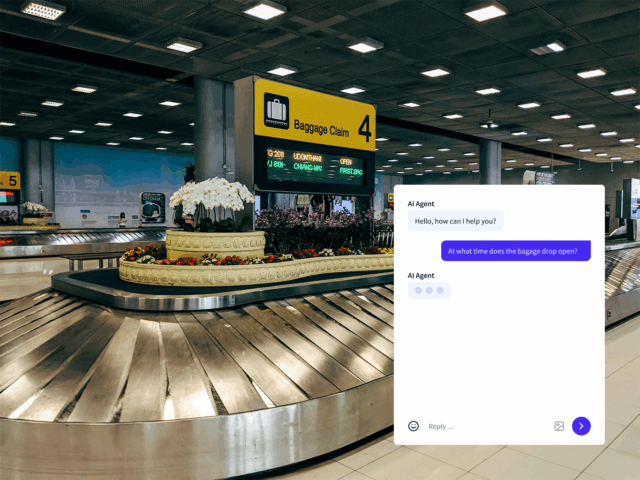
And the Same Applies at the Airport

Another scenario Serge mentions comes from aviation. “Imagine I’m at the airport in Vancouver and want to rebook my ticket for next week. Because of the time difference, customer service might be unavailable, but that doesn’t matter. The AI agent can identify me, pull up my booking, and show me which flights can be rebooked.”

Such a system can even help with questions like:

  • What time does baggage drop open?
  • Can I purchase lounge access?
  • Is my flight on time?

These are tasks that don’t necessarily require human intervention. They’re well-defined, repetitive, and easy to execute within clear boundaries. And that’s exactly where Agentic AI shines: performing 24/7 tasks that would otherwise consume significant time, without taking risks or making decisions outside the rules your organization has set.

Traceability as the Key to Trust

A critical aspect of Agentic AI, Serge explains, is the traceability of its answers.
“Every response an AI agent gives must be trackable. We need to be able to trace which question was asked, which agent handled it, and what answer it produced. That way you can later analyze where something went wrong or how to improve the prompt.”

This transparency not only improves the system, but also enhances safety. Organizations must be able to show how an answer was generated, especially in sectors like healthcare, telecom, or financial services.

AI as an Assistant, Not a Replacement

Ultimately, Agentic AI isn’t about replacing people. It’s about using technology more intelligently. The reality is that many employees spend a lot of time on repetitive tasks. Explaining six times a day that walk-in hours are from ten to four-thirty, or that a ticket can’t be rebooked yet, isn’t exactly inspiring work. If AI can take over those tasks, employees can focus on conversations that actually add value.

Or, as Serge puts it:
“Agentic AI isn’t meant to make people redundant, but to support them. So customers are helped faster, employees gain more satisfaction from their work, and organizations can perform more consistently.”

Agentic AI is not a magical, all-knowing system, but a carefully designed ecosystem of smart, traceable, and specialized agents, where humans are still firmly in control.