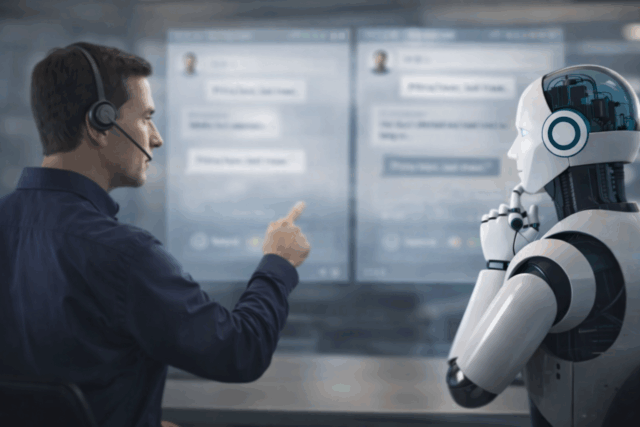
In many service environments, the first point of contact is AI: a chatbot answering simple, repetitive questions such as “Where is my package?” or “How can I change my appointment?” Or a voice bot that opens the conversation, identifies intent, and routes customers directly to the right agent.
AI handles the groundwork by clarifying context, retrieving relevant information, and assessing urgency, so agents do not have to start from scratch.
During live interactions, AI can listen in to provide suggestions, surface relevant knowledge articles, or propose next steps while the agent remains fully in control. When AI detects signals of rising frustration, uncertainty, or emotional stress, it acts as an early warning system, prompting agents to adjust their communication or take over the conversation immediately.
For complex cases (such as conflicting information, exceptions, or customers requiring tailored solutions) the interaction automatically shifts to a human who can assess the nuance. The result is a hybrid model in which AI provides structure and efficiency, while humans contribute empathy, creativity, and judgment. This creates a service experience that is both fast and efficient, yet personal and trustworthy.