Call us now Nederlands

What is a voicebot?

You may already be talking to one every day. On your phone, you ask a question to ChatGPT, Gemini, or another digital assistant. Or when you call customer service and are greeted by an automated voice that helps you with your request. What once started with simple menu options (“press 1 for sales, press 2 for service”) has evolved into intelligent voice assistance. But what exactly is a voicebot? And how does it differ from a chatbot?

A voicebot explained

A voicebot is an automated system that communicates through speech. Instead of typing, you speak your question. The voicebot understands it, processes it, and responds with a spoken answer.

It may sound simple, but a lot happens behind the scenes. The voicebot converts speech into text (speech-to-text), analyzes the intent behind the question, retrieves information from a knowledge source, and then converts the response back into speech (text-to-speech).

The result: a natural interaction that feels like a real conversation.

Voicebots are increasingly used in customer contact scenarios. For example:

  • Providing opening hours

  • Modifying an appointment

  • Checking an order status

  • Answering frequently asked questions

They are available 24/7 and handle routine inquiries, freeing up employees to focus on more complex tasks.
A voicebot is not a chatbot

Although the terms are often used interchangeably, a voicebot is not the same as a chatbot.

A chatbot operates through text: via a website, WhatsApp, or social media.
A voicebot operates through speech: usually over the phone or via a voice assistant.

The difference is not just the channel, but also the interaction dynamic. Voice conversations move faster and are more direct, requiring a different approach to instructions and responses. There is less room for long explanations. Tone and phrasing must align with how people naturally speak and listen.

How does a voicebot work in practice?

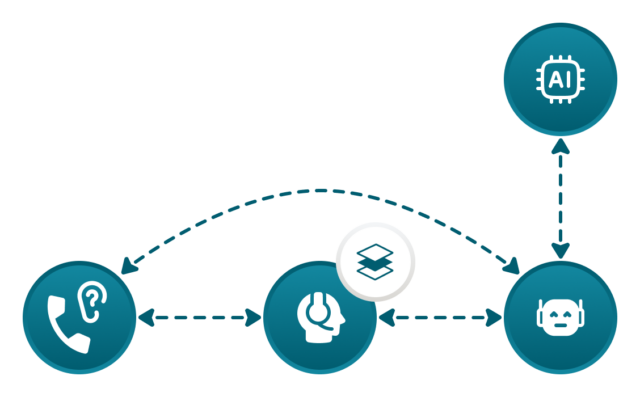
In practice, a customer calls your contact center, or directly dials a dedicated number connected to the voice layer. This voice layer acts as the bridge between telephony and the underlying AI platform. As soon as the customer speaks, the system converts the speech into text, analyzes the intent, and sends this information to the AI platform. The platform generates an appropriate response, which is then converted back into speech and played to the customer.

The voicebot itself doesn’t “know” everything; it works together with the AI platform and, if needed, other systems such as a CRM, knowledge base, or scheduling tool.

An example of such an instruction might be:

“You are a customer-friendly assistant who provides short, businesslike answers. You only provide information about the opening hours and service conditions of our stores. For questions about pricing and returns, you transfer the call to the store. After a maximum of three customer questions, you transfer the call to the central office.”

These types of instructions determine how the voicebot responds, what information it is allowed to share, and when it should transfer the conversation to a human agent.

That boundary is crucial. A well-designed voicebot not only knows what to say, but also when to stop — and when it’s time to hand the conversation over to a human colleague.

A customer calls the contact center or is routed directly to the voice layer, which communicates with the AI platform.

Why voicebots are becoming more popular

Adoption of voicebots is growing rapidly. One reason is that they align with how people naturally communicate: speaking is faster than typing.

They also offer clear benefits for organizations:

  • Shorter waiting times

  • 24/7 availability

  • More efficient use of staff

  • Consistent answers

However, success depends on proper implementation. A voicebot that tries to do too much or operates outside its knowledge domain leads to frustration. A voicebot with clear boundaries and smooth handovers enhances the customer experience.

When should you use a voicebot?

Voicebots are particularly effective for repetitive, predictable questions. Such as opening hours, status updates, or simple changes.

For complex, emotional, or exceptional situations, human interaction remains essential. The real strength lies in the combination: technology for speed and scalability, people for nuance and empathy.

The future of voice

Voice is becoming an increasingly natural part of digital interaction. From smart speakers to AI assistants on smartphones, voice is no longer an experiment. It’s a mature channel.

A voicebot is not a gimmick, but a strategic component of modern customer contact. When properly designed, with clear instructions and defined boundaries, a voicebot can deliver faster service and create greater operational calm within your organization.