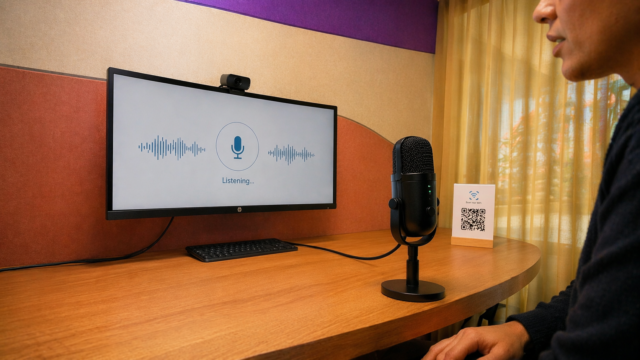
Everything starts with sound. A customer calls and says: “I want to know where my order is.” That isn’t understood in one go. The system works through roughly four steps:
1. Audio → text The system converts the sound into plain text. The audio is broken down into small fragments and analysed for phonemes. Based on this, the system recognises words and constructs a sentence.
2. Text → interpretation That sentence is then analysed to determine what the customer actually wants. A language model looks at the context and identifies the intent behind the words: Customer wants to track their order (track & trace request).
3. Interpretation → action The recognised intent is linked to an action in the system: → Retrieve track & trace information → Or route to the correct department
4. Text → audio (the response) Finally, the system formulates a reply. The outcome (“Your package will be delivered tomorrow”) is first composed as text and then converted to speech.
In less than a second, the system translates sound into understanding, understanding into action, and back again into a naturally-sounding response. For the customer, it feels like one seamless conversation. While multiple intelligent steps are happening behind the scenes.