WhatsApp Talk with us Nederlands

What is RCS? Rich Communication Services explained

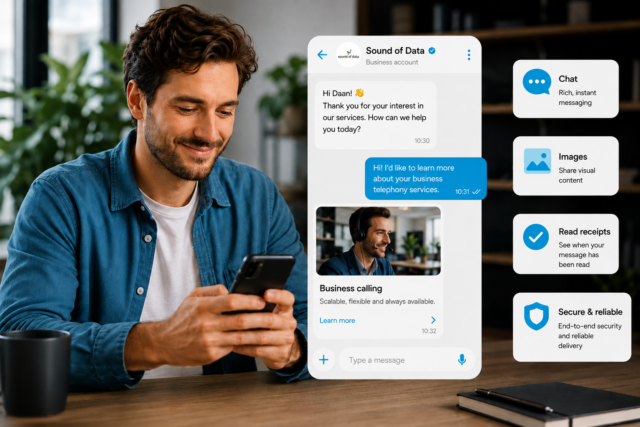
RCS stands for Rich Communication Services. It's the official successor to SMS. It runs natively on your phone, no extra app needed, and brings everything SMS was missing: images, videos, read receipts, interactive buttons.

Is it comparable to WhatsApp? Partly. The features overlap, but the real difference sits in the infrastructure. WhatsApp is an app owned by Meta. RCS is an open standard, built into your phone and managed through your carrier. Nothing to download, no account to create.

RCS stands for Rich Communication Services

RCS is a messaging standard. It was developed by GSMA, the international trade body behind mobile networks, and pushed hard by Google. The idea: replace SMS with something that feels like a modern messaging app, built right into your phone’s default messages app.

On Android devices, RCS runs by default through Google Messages, the built-in messaging app. Nothing to install. It’s simply there. On iOS it’s possible too, but you have to switch it on yourself. Apple added support with iOS 18; you can enable RCS in the Messages settings.

There’s one condition that often gets overlooked: your carrier needs to have RCS turned on. Without that, your device doesn’t matter. With RCS, a business can send messages with high-resolution images, videos, action buttons, carousels, and a verified sender name. The recipient sees exactly who’s messaging them, logo included, and can reply, confirm an order, or book an appointment with a single tap. That’s a fundamentally different experience from the plain text line SMS has sent for thirty years.

What's the difference with SMS?

SMS works on any device, without internet. That’s its strength and its ceiling in one. No formatting, no buttons, no read receipts, no way to know if your message even landed. And encryption? Not part of the deal. SMS traffic can, in principle, be intercepted.

RCS runs on data: wifi or mobile internet. That makes it richer, faster, and better secured than SMS. Messages get encrypted in transit. As a recipient, you can see when someone’s typing, whether your message was read, and reply directly.

For organizations, that changes the picture. SMS leaves you guessing: did it arrive? Get read? Get ignored? RCS hands you real engagement data. Open rates up to 98% have been reported. When cosmetics brand Clarins switched from SMS to RCS, customer engagement rose 2.5 times.

SMS still wins on reach. Every device, every carrier, no internet required. That keeps it the right choice for OTP codes, urgent alerts, and any situation where reach matters more than anything else.

Will RCS become the new standard?

That’s the question everyone’s asking. The honest answer: it’s on its way, but there are still bumps in the road. The tipping point was Apple’s move. In iOS 18, Apple added RCS support to its standard Messages app. That was the breakthrough the Android world had waited years for: finally, one universal messaging protocol between Android and iPhone. There are now 1.5 billion RCS users worldwide.

In the Netherlands, March 2026 set the tone. At Mobile World Congress in Barcelona, KPN, Twilio, and Google announced a partnership for nationwide RCS Business Messaging. Any organization sending messages to customers runs into one critical point: RCS Business Messaging has no end-to-end encryption. Messages get encrypted in transit, but not end-to-end. That sets RCS apart from WhatsApp, which encrypts end-to-end by default. For sectors like healthcare, finance, or legal services, that’s a real consideration.

RCS, WhatsApp, or SMS: what do you pick, and when?

SMS WhatsApp RCS
App required No Yes No
Reach Universal 3+ billion users 1.5 billion, growing
Rich media No Yes Yes
Interactive buttons No Yes Yes
End-to-end encryption No Yes (default) No (business)
Verified sender No Yes Yes
Platform owner Carrier Meta Google / carriers

WhatsApp dominates in the Netherlands. More than 3 billion users worldwide, end-to-end encryption by default, and an interface everyone already knows. For customer contact, it offers everything SMS lacks. The trade-off: you’re building on Meta’s platform, subject to Meta’s pricing and Meta’s decisions. Organizations looking to spread that risk start eyeing alternatives.

RCS is that alternative. No Meta, no extra app, and just as rich in what it can do. The rollout in the Netherlands is real. The infrastructure is there. The open question is whether your customers already have RCS on their device, and whether your platform is ready for it.

What does this mean for customer contact?

RCS opens doors SMS never could. Picture an appointment confirmation with a button to reschedule on the spot, a delivery notification with a photo of the package, or a service alert the customer can respond to with one tap. The interaction gets richer, and the customer doesn’t have to install a thing. WhatsApp already offers this too, to be fair: buttons, carousels, images, video, and interactive templates are all available through the Business API. The difference sits in the infrastructure, not the feature set.

Still, RCS won’t work everywhere tomorrow. Android has it on by default, but iOS users need to switch it on themselves in settings. Plenty won’t bother. On top of that, RCS depends on the carrier: if they haven’t enabled the protocol, it won’t work. No matter the device.

The bar can go up. Whether it actually does depends on how fast reach grows and whether organizations take the step to put RCS to work. Want to keep up with what’s happening around RCS and customer contact? Follow us on LinkedIn or sign up for our newsletter.