WhatsApp Talk with us Nederlands

From sampling to 100% conversation analysis

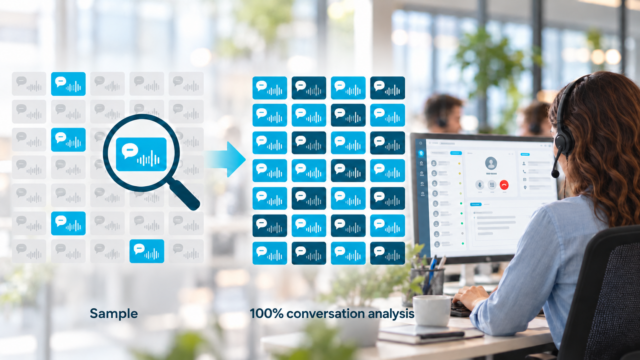
In most contact centres, a quality coach reviews a handful of conversations per agent each month. A survey among contact centres found that two thirds listen back to six conversations or fewer per agent per month. An agent who handles forty calls a day reaches well over eight hundred in a month. Five reviewed conversations then amount to less than 1 percent.

That small fraction is what you base coaching, evaluations and improvement plans on. In this blog, you’ll read what a sample overlooks and what changes when you analyse every conversation. We use Puzzel Conversational Intelligence as an example, because we implement that platform for our clients.

What a sample overlooks

A sample is meant to give a reliable picture of the whole. With customer conversations, that rarely works. The conversations that matter most are uncommon, so they seldom end up in the selection. Think of a customer threatening to cancel, a recurring fault or an agent explaining a procedure incorrectly.

The coach’s choice also plays a role. Whoever selects the conversations often picks the long ones or the ones with a complaint. That gives a distorted view of how an agent performs. For the agent, it also feels unfair. One difficult call can weigh heavily in an evaluation that rests on five conversations.

Finally, there is a delay between the conversation and the feedback. A coach often listens back days or weeks later. By then, the agent barely remembers the call, and a problem with a new product or a new way of working has already occurred hundreds of times.

How 100% conversation analysis works

With 100% conversation analysis, software processes every customer conversation automatically. In Puzzel Conversational Intelligence, this starts with speech recognition, also known as ASR (automatic speech recognition). Puzzel uses its own ASR technology to convert spoken words into a readable transcript.

The system then analyses that transcript using NLP (natural language processing). It recognises topics, sorts conversations into categories and measures customer sentiment. Generative AI turns each conversation into a short summary, so agents spend less time on after-call work.

Besides phone calls, Puzzel Conversational Intelligence also analyses chat and email, giving you a single view of all customer contacts. If you want to record and analyse calls, check the rules first. Our blog on recording phone calls explains what is allowed and what to look out for.

What you see when you analyse everything

With every conversation in view, the question shifts from “how did this agent do?” to “why are customers calling us?”. Puzzel Conversational Intelligence automatically looks for patterns that explain why calls take long or why customers call back. This shows you where agents lack knowledge and which processes cause customers to call unnecessarily.

It also helps you spot new problems quickly. If the number of calls about an invoice or an outage rises, you see it in the analysis shortly after those calls, well before the monthly report.

For coaching, it means a team leader can work with real examples. They can see where an agent excels, where there is room for improvement and which conversations can serve as good examples for the rest of the team.

On its product page, Puzzel lists several customer results. According to Puzzel, a telecom provider with around 80 agents saves over 400 hours a month by analysing calls automatically. Lyreco used the insights for more targeted coaching and reduced its average call duration by 15 percent.

The quality coach’s role is changing

A common concern is that automatic analysis makes the quality coach redundant. In practice, the job shifts. Puzzel Conversational Intelligence combines automatic and manual quality assurance. The software analyses every conversation and shows where attention is needed. The coach reviews those conversations and turns them into feedback.

As a result, the coach spends less time searching and more time talking with the agent. An evaluation rests on patterns from hundreds of conversations instead of a random selection of five. That makes the feedback more concrete and easier for the agent to act on.

This does require clear agreements. Agents need to know which conversations are analysed and what the results are used for. Use the analysis for development, and you build support on the work floor.

Getting started with conversation analysis

Start with one question you can’t answer properly today. For example, why customers call back within a week, or why call duration is rising in a particular queue. This quickly shows what the analysis delivers, and you can build from there.

Sound of Data implements Puzzel Conversational Intelligence and helps you set it up, from the integration with your contact centre to the agreements with your team. Read more about the value of customer conversations in our blog The data is already in your customer conversations.

Want to know what 100% conversation analysis means for your contact centre? Read how we turn customer contact into insight and value, or get in touch for a no-obligation conversation.